
Perc test and soil evaluation in Maricopa and Pinal counties
This is the measurement everything else hangs on. Before anyone can design a septic system for an Arizona property, somebody has to establish what the ground will actually do with the effluent. The result decides whether you are pricing a conventional system or an engineered one, which is the largest single difference in the quote.
What actually gets measured
"Perc test" is the shorthand, but the useful work is broader than the water-in-a-hole part. A site and soil evaluation looks at:
- The soil profile with depth. Texture and structure layer by layer, not just at the surface, because the layer that decides the answer is usually not the one you can see.
- Depth to a restrictive layer. Bedrock, or caliche, the cemented hardpan common across the Sonoran Desert that stops water moving downward.
- Depth to seasonal high groundwater. The separation between the bottom of a disposal field and groundwater is what gives the soil room to finish treating effluent.
- Slope across the proposed field area. Which affects whether effluent stays where it is put.
- The percolation rate itself. How fast water actually moves out of the test hole.
- Where a field could physically go. Setbacks, access and available area often constrain the design as much as the soil does.
Percolation is not a pass or fail with one threshold. It is a band, and a lot can fall off either end of it. Both ends lead to the same place: an alternative or engineered system.
- Percolates too fast
- Coarse sand and gravel. Effluent reaches groundwater before the soil finishes treating it.
- Workable for a conventional system
- The soil takes effluent at a rate it can also treat.
- Percolates too slowly
- Tight clay, caliche influence. Effluent backs up or surfaces.
We publish no threshold figure here on purpose. Arizona's design criteria sit in A.A.C. Title 18, Chapter 9, Article 3 and are applied by the county reviewing your design, so the number that matters is the one your designer works to, not one copied off a website. Ask for the measured rate and what it rules in or out.
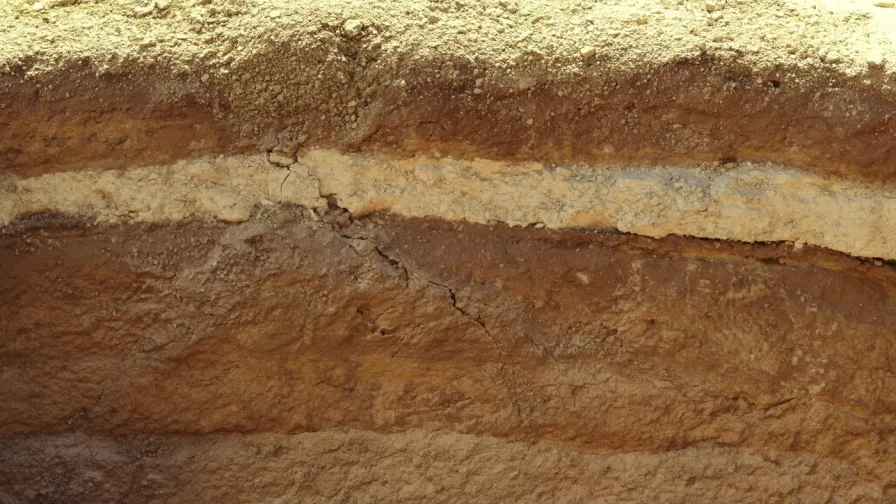
Why caliche makes this less predictable than elsewhere
If you have owned property in a wetter part of the country, the Arizona version of this test can surprise you. Caliche is a hardpan layer formed where minerals have accumulated and cemented in the soil profile. It behaves like rock: water reaching it moves sideways rather than continuing down.
A parcel can have perfectly workable-looking topsoil and still be unsuitable for a conventional disposal field because of a caliche layer a few feet beneath it. This is why the evaluation goes deeper than people expect, why a hole dug by eye tells you very little, and why neighboring lots can produce genuinely different answers.
What the result means for you
- Inside the workable band. A conventional tank and disposal field is on the table, sized to the house. This is the cheaper path.
- Outside it, either end. The property is heading toward an alternative or engineered system, which adds a designer, more equipment, and ongoing maintenance obligations.
- Constrained by area or setbacks rather than by soil. Sometimes the soil is fine and the buildable envelope is the problem. That is a design conversation, not necessarily a system-type one.
Whichever you get, ask for the measured result in writing and for a plain statement of what it rules in and out. You need it to compare quotes honestly: two prices for two different system types are not the same quote.
Which county permits your system
Arizona delegates on-site wastewater permitting to counties, and the two in this service area run separate programs. Find your county before you start any paperwork.
Maricopa County
Permitting and inspections run through Maricopa County Environmental Services. Covers the unsewered Phoenix metro fringe: Buckeye, Cave Creek, New River, Rio Verde, the Surprise fringe and the Queen Creek edges.
Source: maricopa.gov, Onsite Wastewater program.
Pinal County
Permitting and inspections run through Pinal County Environmental Health. Covers Casa Grande, Apache Junction, San Tan Valley and the city of Maricopa, which despite the name is in Pinal County, not Maricopa County.
Source: pinal.gov, Environmental Health.
When to order one
- Before buying unsewered land. The single highest-value time to do it.
- Before designing a new system on a property that has never had one.
- Before a replacement, where the failure may point at soil that was never suitable rather than at a worn-out component.
- When a field has failed twice. Repeating a design that the ground already rejected is a common and expensive mistake.
Requirements and review are administered by the county that governs the property. Status as of September 2026. Confirm current requirements with Maricopa County Environmental Services or Pinal County Environmental Health before relying on anything here.
For how the result feeds into everything else, see the Arizona Septic System Guide and the lot suitability guide.
Get a free quote on a perc test or soil evaluation
Questions homeowners ask
- Is a perc test the same thing as a soil evaluation?
- Not quite, and the difference matters. A percolation test measures how fast water moves out of a test hole. A site and soil evaluation is the broader assessment: soil profile and texture with depth, depth to bedrock or a restrictive layer such as caliche, depth to seasonal high groundwater, slope, and where a disposal field could physically go. The perc rate is one input to that. A design gets built on the evaluation, not on the perc number alone.
- Can a lot fail a perc test?
- It can fall outside the workable band in either direction, which is the part people do not expect. Too slow and effluent backs up or surfaces. Too fast and it reaches groundwater before the soil has finished treating it. Neither result means the land is unbuildable. It means a conventional system is not the answer and the property is heading toward an alternative or engineered design.
- How long is a perc test valid?
- That is a question for the county reviewing your design rather than one with a single statewide answer, and Maricopa County Environmental Services and Pinal County Environmental Health run separate programs. Ask the county directly before relying on an older test, particularly if site conditions or the proposed field location have changed.
- Should I get a perc test before buying land?
- If the parcel has no sewer connection available and no existing permitted system, it is one of the most useful things you can do before closing. The result decides whether the property carries a conventional system or an engineered one, and that is the largest single cost difference in an Arizona septic project. Finding out afterwards is an expensive way to learn it.
What it costs, and what happens after you send it
- What does a septic system cost in Maricopa and Pinal County?
- There is no sourced Arizona-specific figure this site is willing to publish, and that is a deliberate choice rather than an omission. Septic pricing has no official schedule, and the local numbers circulating on other sites carry no attribution anyone can check. What is checkable is the county side: Pinal County publishes $296 for a permit to construct a septic tank system under 2,999 gallons per day and $400 for an alternative on-site system. Those are county permit fees, which is what the county charges rather than what a contractor charges, and both counties publish their transfer fees as well. As a rough sanity check on the shape of the numbers rather than as an Arizona price, Bob Vila's cost guide, updated January 2023 gives $3,500 to $10,000 for a conventional system and $12,000 to $15,000 for an engineered one, alongside a national average of $6,361 for a septic tank. That guide is three years old and it is national, so treat the gap between conventional and engineered as the useful signal rather than the absolute figures. Which side of that gap your lot falls on is a soil question rather than a shopping question. Caliche, poor percolation, shallow bedrock, steep slope or a high water table are what push a property onto an alternative or engineered system, and a perc test and soil evaluation is what settles it. The construction cost itself comes from a licensed contractor who has seen your soil.
- How fast will someone get back to me?
- Your request goes to a licensed local septic contractor, usually within about an hour during the day. That contractor then contacts you to look at the property and price the work on their own schedule.
- What work is covered?
- New septic system installation, system replacement, drain field and leach field replacement, alternative and engineered systems, perc test and soil evaluation, and the transfer of ownership inspection. See every service.
Only a contractor standing on your property can price the actual job.
Ready to price a septic replacement?
Tell us where the property is and what the system is doing. The quote comes back free and with no obligation, and the work gets scheduled from there.
Get a Free QuoteUpdated