
Drain field and leach field replacement in Maricopa and Pinal counties
The disposal field is the part of a septic system that wears out first, and replacing it is a smaller job than replacing the whole system. Establishing that the field is genuinely the problem, before anyone quotes you, is the most valuable thing you can do here.
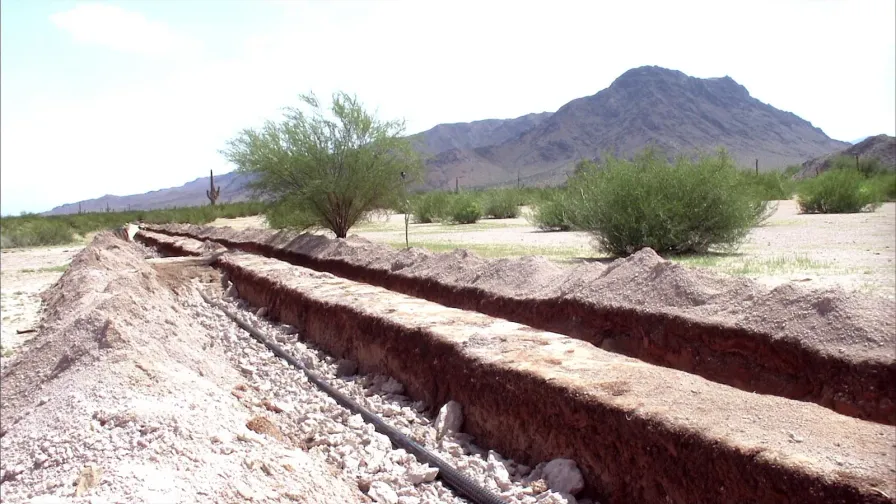
What the field does, and how it fails
The tank settles solids. The disposal field, also called the leach field, distributes the liquid into the ground, where the soil finishes treating it. That means the field depends entirely on the soil continuing to accept water.
Fields stop accepting water for two quite different reasons, and they are not equally fixable:
- Gradual clogging at the soil interface. A biological layer builds up where effluent meets soil and eventually seals it. This is the ordinary end-of-life failure and the case where replacement in a new area is straightforward.
- The soil was never right. The field was installed in ground that could not sustain the load, so it failed early and would fail again if rebuilt the same way in the same place. Here the fix is a design question, not an excavation question.
A contractor who cannot tell you which of those two you have is guessing, and the second one quietly turns a field replacement into a system redesign.
Field or tank: the test that separates them
The most useful single indicator is how long a pump-out lasts. If pumping the tank relieves the problem for weeks rather than years, the tank is filling because it has nowhere to drain to, which points at the field. Supporting signs:
- Wet ground, ponding or soft spots over the field area when it has not rained.
- Unusually vigorous green growth over the field in dry conditions.
- Odour outdoors concentrated over the field rather than over the tank.
- Slow drains throughout the house at once rather than at a single fixture, which usually indicates a plumbing blockage instead.
Where the replacement can go
This is the constraint that decides how big the job gets. A replacement field needs suitable soil, enough area, and compliance with setbacks, and it usually cannot simply reoccupy the failed footprint. On a large parcel with good ground there is room to move and the project stays modest. On a constrained lot, or where the surrounding soil is no better than the soil under the failed field, the honest answer may be a different system type rather than a relocated field.
Caliche is often the hidden factor. A cemented hardpan layer under the disposal area stops water moving downward whatever the surface soil does, and it does not stop at the property line. If caliche caused the failure, a new field a few meters away may meet the same layer. A soil evaluation is what settles it.
Which county permits your system
Arizona delegates on-site wastewater permitting to counties, and the two in this service area run separate programs. Find your county before you start any paperwork.
Maricopa County
Permitting and inspections run through Maricopa County Environmental Services. Covers the unsewered Phoenix metro fringe: Buckeye, Cave Creek, New River, Rio Verde, the Surprise fringe and the Queen Creek edges.
Source: maricopa.gov, Onsite Wastewater program.
Pinal County
Permitting and inspections run through Pinal County Environmental Health. Covers Casa Grande, Apache Junction, San Tan Valley and the city of Maricopa, which despite the name is in Pinal County, not Maricopa County.
Source: pinal.gov, Environmental Health.
Questions to ask before you sign
- What evidence shows the field failed rather than the tank?
- Which failure is it: interface clogging, or unsuitable soil?
- Where will the new field go, and what is the soil like there specifically?
- Is the existing tank sound, sized correctly for the house, and staying?
- Is a permit required for this work, and who pulls it?
- What documentation will I hold afterwards?
If it turns out the tank is failing too, or the system was undersized from the start, you are looking at a full replacement instead. The Arizona Septic System Guide covers how the two compare and what the ground does to both.
Get a free quote on a drain field replacement
Questions homeowners ask
- How do I know it is the field and not the tank?
- The clearest signal is a backup that returns quickly after a pump-out. If pumping buys you weeks rather than years, the tank is emptying into ground that is no longer accepting it. Wet spots, ponding or unusually green growth over the field area in dry weather point the same way. A contractor should confirm it rather than infer it, because the two repairs are very different amounts of money.
- Can a failed drain field be restored instead of replaced?
- Various restoration treatments are marketed. Be careful here and ask what specifically is being treated: a field that has clogged at the soil interface is a different problem from one that failed because the soil was never capable of taking the load, and no treatment fixes the second. Ask what evidence supports the diagnosis before paying for a remedy.
- Can the new field go in the same place?
- Sometimes, but not always, and this is where projects grow. A field that failed because the soil there is unsuitable will fail again in the same spot. Setbacks, available area and the location of the original field all constrain where a replacement can go, and on a constrained lot that can push the design toward an alternative or engineered system.
- Does a field replacement need a permit?
- Work on an on-site wastewater system is permitted and inspected by the county that governs the property, and Maricopa and Pinal run separate programs. Confirm the requirement with your county before work starts rather than after. Keep the resulting paperwork: under A.A.C. R18-9-A316(D) the permitting and maintenance documents in your possession go to the buyer when you sell. Status as of September 2026.
What it costs, and what happens after you send it
- What does a septic system cost in Maricopa and Pinal County?
- There is no sourced Arizona-specific figure this site is willing to publish, and that is a deliberate choice rather than an omission. Septic pricing has no official schedule, and the local numbers circulating on other sites carry no attribution anyone can check. What is checkable is the county side: Pinal County publishes $296 for a permit to construct a septic tank system under 2,999 gallons per day and $400 for an alternative on-site system. Those are county permit fees, which is what the county charges rather than what a contractor charges, and both counties publish their transfer fees as well. As a rough sanity check on the shape of the numbers rather than as an Arizona price, Bob Vila's cost guide, updated January 2023 gives $3,500 to $10,000 for a conventional system and $12,000 to $15,000 for an engineered one, alongside a national average of $6,361 for a septic tank. That guide is three years old and it is national, so treat the gap between conventional and engineered as the useful signal rather than the absolute figures. Which side of that gap your lot falls on is a soil question rather than a shopping question. Caliche, poor percolation, shallow bedrock, steep slope or a high water table are what push a property onto an alternative or engineered system, and a perc test and soil evaluation is what settles it. The construction cost itself comes from a licensed contractor who has seen your soil.
- How fast will someone get back to me?
- Your request goes to a licensed local septic contractor, usually within about an hour during the day. That contractor then contacts you to look at the property and price the work on their own schedule.
- What work is covered?
- New septic system installation, system replacement, drain field and leach field replacement, alternative and engineered systems, perc test and soil evaluation, and the transfer of ownership inspection. See every service.
Only a contractor standing on your property can price the actual job.
Ready to price a septic replacement?
Tell us where the property is and what the system is doing. The quote comes back free and with no obligation, and the work gets scheduled from there.
Get a Free QuoteUpdated